
Am I eligible?
You are eligible for Part A at no cost at age 65 if any of the following conditions apply:
You receive or are eligible to receive benefits from Social Security or the Railroad Retirement Board (RRB).
Your spouse (living or deceased, including a divorced spouse) receives or is eligible to receive Social Security or RRB benefits.
You or your spouse worked long enough in a government job where you paid Medicare taxes.
You are the dependent parent of a fully insured deceased child.


Lis
⭐⭐⭐⭐⭐
Amazing Broker. He lowered my insurance policy and I got a better deal in the coverage. What else I can ask. Fully recommend
Am I eligible?

You are eligible for Part A at no cost at age 65
if any of the following conditions apply:
You receive or are eligible to receive benefits from Social Security or the Railroad Retirement Board (RRB).
Your spouse (living or deceased, including a divorced spouse) receives or is eligible to receive Social Security or RRB benefits.
You or your spouse worked long enough in a government job where you paid Medicare taxes.
You are the dependent parent of a fully insured deceased child.
Medicare Eligibility Before Age 65

Before age 65, you are eligible for Medicare Part A at no cost if any of the following conditions apply:
You’ve received Social Security Disability Insurance (SSDI) benefits for 24 months.
You receive a disability pension from the Railroad Retirement Board (RRB) and meet certain conditions.
You receive SSDI benefits and have Lou Gehrig’s disease (amyotrophic lateral sclerosis).
You worked long enough in a government job where you paid Medicare taxes and have met the requirements of the SSDI program for 24 months.
You are the child or surviving spouse (age 50 or older, including a divorced surviving spouse) of a worker who has worked long enough under Social Security or in a Medicare-covered government job and meet the requirements of the SSDI program.
Kidney Failure Before Age 65

You have permanent kidney failure (end-stage renal disease) and receive maintenance dialysis or a kidney transplant, and one of the following applies:
You’ve worked long enough under Social Security or the railroad retirement system.
You’ve worked long enough in a Medicare-covered government job.
You are the child or spouse (including a divorced spouse) of a worker (living or deceased) who has worked long enough under Social Security or the railroad retirement system, or in a Medicare-covered government job.
*Note: Anyone eligible for Medicare Part A at no cost can enroll in Medicare Part B by paying a monthly premium. Those with higher incomes may have to pay a higher monthly premium for Part B.
If you are not eligible for Part A at no cost, you can purchase Part B without needing to buy Part A. To be eligible, you must be age 65 or older and meet one of the following criteria:
Be a U.S. citizen.
Be a lawfully admitted noncitizen who has lived in the United States for at least 5 years. You can only sign up for Part B during designated enrollment periods. If you don't enroll in Part B when you are first eligible, you may have to pay a late enrollment penalty for as long as you have Part B coverage.
Medicare Eligibility Before Age 65
Before age 65, you are eligible for Medicare Part A at no cost if any of the following conditions apply:
You’ve received Social Security Disability Insurance (SSDI) benefits for 24 months.
You receive a disability pension from the Railroad Retirement Board (RRB) and meet certain conditions.
You receive SSDI benefits and have Lou Gehrig’s disease (amyotrophic lateral sclerosis).
You worked long enough in a government job where you paid Medicare taxes and have met the requirements of the SSDI program for 24 months.
You are the child or surviving spouse (age 50 or older, including a divorced surviving spouse) of a worker who has worked long enough under Social Security or in a Medicare-covered government job and meet the requirements of the SSDI program.
Kidney Failure Before Age 65
You have permanent kidney failure (end-stage renal disease) and receive maintenance dialysis or a kidney transplant, and one of the following applies:
You’ve worked long enough under Social Security or the railroad retirement system.
You’ve worked long enough in a Medicare-covered government job.
You are the child or spouse (including a divorced spouse) of a worker (living or deceased) who has worked long enough under Social Security or the railroad retirement system, or in a Medicare-covered government job.
*Note: Anyone eligible for Medicare Part A at no cost can enroll in Medicare Part B by paying a monthly premium. Those with higher incomes may have to pay a higher monthly premium for Part B.
If you are not eligible for Part A at no cost, you can purchase Part B without needing to buy Part A. To be eligible, you must be age 65 or older and meet one of the following criteria:
Be a U.S. citizen.
Be a lawfully admitted noncitizen who has lived in the United States for at least 5 years. You can only sign up for Part B during designated enrollment periods. If you don't enroll in Part B when you are first eligible, you may have to pay a late enrollment penalty for as long as you have Part B coverage.
Medicare Parts A
and B – Enrollment
Initial Enrollment: The Initial Enrollment Period is a limited timeframe during which you can sign up for Original Medicare (Part A and/or Part B) when you first become eligible.
Once enrolled in Medicare Parts A and B, you have the option to choose additional coverage, such as Medicare Advantage, Medigap, or Part D, from approved private insurers.
Individuals Aged 65 or Older
Your Initial Enrollment Period is determined by the month you turn 65. It starts three months before your birth month and continues until three months after your birth month.
Your enrollment period lasts 7 months, based on the month you turn 65.
Example: If your birthday is January 12th, 1958, your enrollment period would be October 1st, 2022 - April 30th, 2023.

Medicare Parts A And B – Enrollment
Initial Enrollment: The Initial Enrollment Period is a limited timeframe during which you can sign up for Original Medicare (Part A and/or Part B) when you first become eligible.
Once enrolled in Medicare Parts A and B, you have the option to choose additional coverage, such as Medicare Advantage, Medigap, or Part D, from approved private insurers.
Individuals Aged 65 or Older
Your Initial Enrollment Period is determined by the month you turn 65. It starts three months before your birth month and continues until three months after your birth month.
Your enrollment period lasts 7 months, based on the month you turn 65.
Example: If your birthday is January 12th, 1958, your enrollment period would be October 1st, 2022 - April 30th, 2023.
Eligible Enrollment Months:

Attention: Individuals Under Age 65 with an Eligible Disability
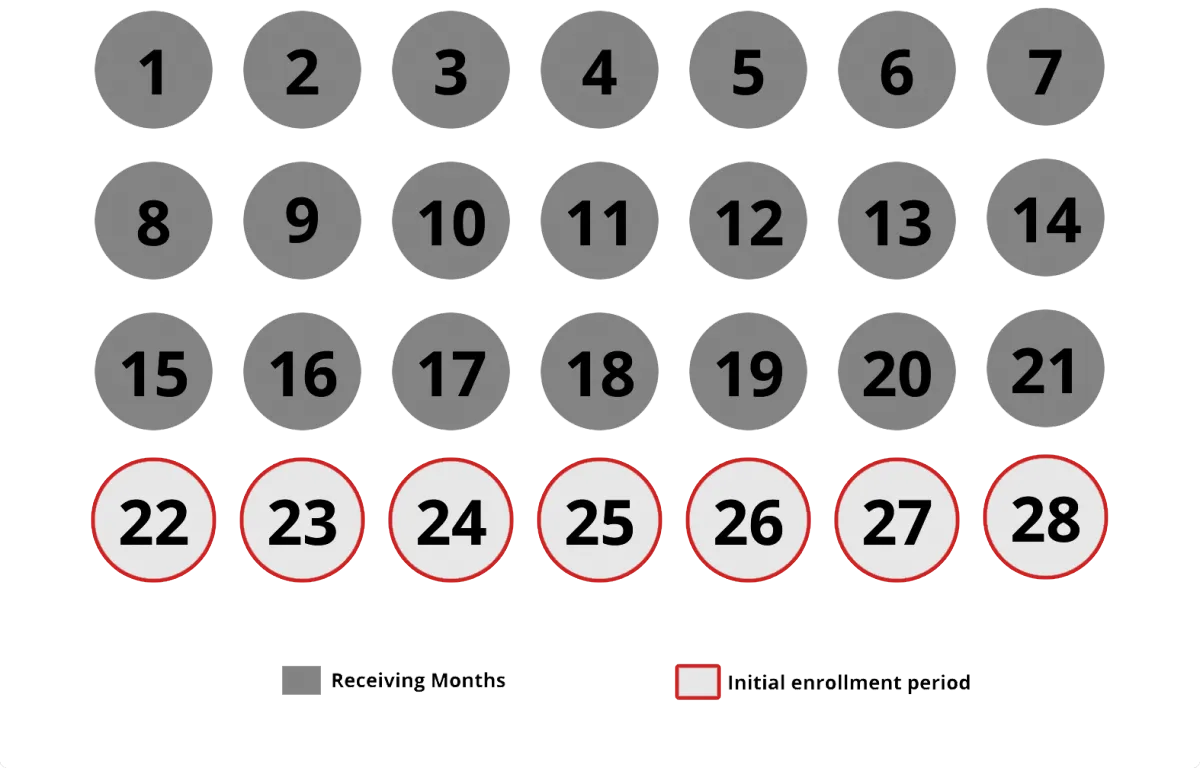
Your Initial Enrollment Period is determined by when you started receiving Social Security or Railroad Retirement Board (RRB) disability benefits. It begins in the 22nd month after you start receiving benefits and lasts until the 28th month after that.
Example: If you began receiving disability benefits in January 2022, your Initial Enrollment Period is from November 1, 2023 until May 31, 2023.
Attention: Individuals Under Age 65 with an Eligible Disability
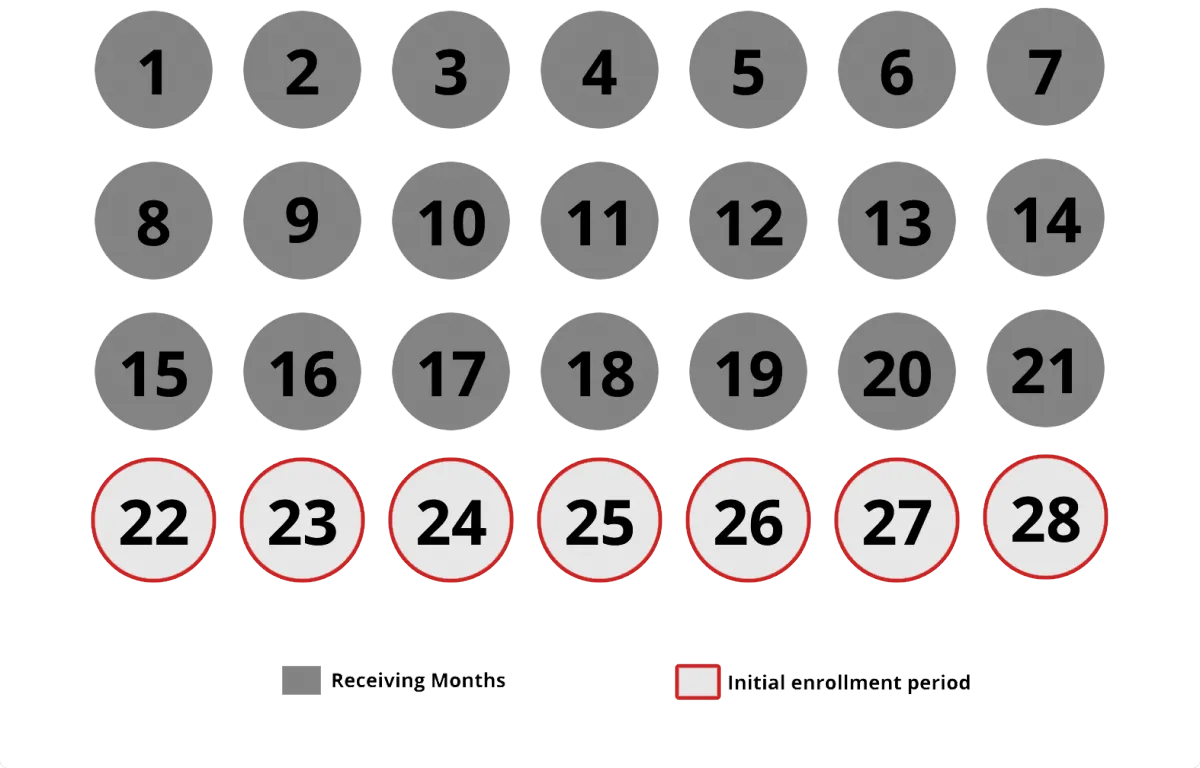
Your Initial Enrollment Period is determined by when you started receiving Social Security or Railroad Retirement Board (RRB) disability benefits. It begins in the 22nd month after you start receiving benefits and lasts until the 28th month after that.
Example: If you began receiving disability benefits in January 2022, your Initial Enrollment Period is from November 1, 2023 until May 31, 2023.
How To Enroll
If you already receive Social Security or certain retirement benefits, you may be automatically enrolled in Original Medicare during this time period.
Open Enrollment Period
(October 15 through December 7)
The Medicare Open Enrollment Period offers an annual chance to review and modify your Medicare coverage.
You can:
Enroll in a Medicare Advantage (Part C) plan.
Discontinue your Medicare Advantage plan and switch back to Original Medicare (Part A and Part B).
Switch from one Medicare Advantage plan to another.
Add or adjust your Prescription Drug.
Coverage (Part D) plan if you are enrolled in Original Medicare.
General Enrollment Period
(January 1 through March 31)
The General Enrollment Period presents an annual chance to enroll in Medicare Part A and/or Part B.
You can:
Sign up for Original Medicare if you weren't automatically enrolled and missed your Initial Enrollment Period.
Enroll in Part B if you have chosen to opt out of automatic enrollment or have previously dropped your coverage.
Note: If you enroll in Part B after your Initial Enrollment Period, you may incur higher premiums unless you qualify for a Special Enrollment Period.
If you enroll in Medicare during this period, your coverage begins on July 1.
* Note: In certain situations, you may qualify for a Special Enrollment Period. This period provides an opportunity to enroll in the Medicare program or make changes to your Medicare options outside of the Initial and annual Open Enrollment Periods.
How To Enroll
If you already receive Social Security or certain retirement benefits, you may be automatically enrolled in Original Medicare during this time period.
Open Enrollment Period
(October 15 through December 7)
The Medicare Open Enrollment Period offers an annual chance to review and modify your Medicare coverage.
You can:
Enroll in a Medicare Advantage (Part C) plan.
Discontinue your Medicare Advantage plan and switch back to Original Medicare (Part A and Part B).
Switch from one Medicare Advantage plan to another.
Add or adjust your Prescription Drug.
Coverage (Part D) plan if you are enrolled in Original Medicare.
General Enrollment Period
(January 1 through March 31)
The General Enrollment Period presents an annual chance to enroll in Medicare Part A and/or Part B.
You can:
Sign up for Original Medicare if you weren't automatically enrolled and missed your Initial Enrollment Period.
Enroll in Part B if you have chosen to opt out of automatic enrollment or have previously dropped your coverage.
Note: If you enroll in Part B after your Initial Enrollment Period, you may incur higher premiums unless you qualify for a Special Enrollment Period.
If you enroll in Medicare during this period, your coverage begins on July 1.
* Note: In certain situations, you may qualify for a Special Enrollment Period. This period provides an opportunity to enroll in the Medicare program or make changes to your Medicare options outside of the Initial and annual Open Enrollment Periods.

FAQ's
Frequently Asked Questions
Automatic Enrollment:
Question: Will I be automatically enrolled in Medicare?
You will be automatically enrolled in Medicare Part A and Part B if you reach age 65 and receive Social Security or Railroad Retirement Board (RRB) retirement benefits. You will also be automatically enrolled if you are under age 65 with an eligible disability.
You will receive a Medicare card in the mail three months before your 65th birthday or your 25th month of disability. It will include instructions for opting out of enrollment for Part B, should you wish to do so.
Manual Enrollment:
If you are not already receiving Social Security benefits, you will not receive a reminder letter. The enrollment period is crucial: you can start signing up three months before your 65th birthday and have until three months after your birth month to complete the process.
Missing this deadline could result in higher premiums.
Question: How do I manually enroll in Medicare?
There are 3 enrollment periods for Medicare. It's important to sign up as soon as possible to avoid penalties or gaps in coverage. You can sign up at: https://www.ssa.gov/medicare/sign-up

FAQ's
Frequently
Asked Questions
Automatic Enrollment:
Question: Will I be automatically enrolled in Medicare?
You will be automatically enrolled in Medicare Part A and Part B if you reach age 65 and receive Social Security or Railroad Retirement Board (RRB) retirement benefits. You will also be automatically enrolled if you are under age 65 with an eligible disability.
You will receive a Medicare card in the mail three months before your 65th birthday or your 25th month of disability. It will include instructions for opting out of enrollment for Part B, should you wish to do so.
Manual Enrollment:
If you are not already receiving Social Security benefits, you will not receive a reminder letter. The enrollment period is crucial: you can start signing up three months before your 65th birthday and have until three months after your birth month to complete the process.
Missing this deadline could result in higher premiums.
Question: How do I manually enroll in Medicare?
There are 3 enrollment periods for Medicare. It's important to sign up as soon as possible to avoid penalties or gaps in coverage. You can sign up at: https://www.ssa.gov/medicare/sign-up
Looking for a First-Class Medicare Consultant?
Looking for a First-Class Medicare Consultant?
Excellent LLC dba Seguro Insurance is committed to serving you at the highest level with all your Medicare needs.
DISCLAIMER: We do not offer every plan available in your area. Any information we provide is limited to those plans we do offer in your area. Please contact Medicare.gov or 1-800-MEDICARE to get information on all of your options.
𝐒𝐄𝐆𝐔𝐑𝐎 𝐈𝐍𝐒𝐔𝐑𝐀𝐍𝐂𝐄
𝐄𝐚𝐠𝐥𝐞 𝐌𝐨𝐮𝐧𝐭𝐚𝐢𝐧, 𝐔𝐓, 84005
𝐋𝐢𝐜𝐞𝐧𝐬𝐞𝐝 𝐏&𝐂, 𝐇𝐞𝐚𝐥𝐭𝐡, 𝐋𝐢𝐟𝐞
𝐀𝐧𝐝𝐫𝐞𝐰 𝐏𝐞𝐡𝐫𝐬𝐨𝐧 𝐍𝐏𝐍: 20406772 | 𝐔𝐓: 944502 𝐀𝐙: 20406772
𝐒𝐞𝐠𝐮𝐫𝐨 𝐈𝐧𝐬𝐮𝐫𝐚𝐧𝐜𝐞 𝐍𝐏𝐍: 22132094 | 𝐔𝐓: 1108981 𝐀𝐙: 3004158989
𝐈𝐧𝐬𝐮𝐫𝐚𝐧𝐜𝐞 𝐃𝐢𝐬𝐜𝐥𝐨𝐬𝐮𝐫𝐞: 𝐈𝐧𝐬𝐮𝐫𝐚𝐧𝐜𝐞 𝐩𝐫𝐨𝐝𝐮𝐜𝐭𝐬 𝐚𝐫𝐞 𝐨𝐟𝐟𝐞𝐫𝐞𝐝 𝐭𝐡𝐫𝐨𝐮𝐠𝐡 𝐒𝐞𝐠𝐮𝐫𝐨 𝐈𝐧𝐬𝐮𝐫𝐚𝐧𝐜𝐞 (𝐍𝐏𝐍: 22132094). 𝐋𝐢𝐜𝐞𝐧𝐬𝐞𝐝 𝐢𝐧 𝐭𝐡𝐞 𝐒𝐭𝐚𝐭𝐞 𝐨𝐟 𝐔𝐭𝐚𝐡 (𝐋𝐢𝐜𝐞𝐧𝐬𝐞: 1108981). 𝐍𝐨𝐭 𝐚𝐥𝐥 𝐩𝐨𝐥𝐢𝐜𝐢𝐞𝐬 𝐨𝐫 𝐩𝐫𝐨𝐝𝐮𝐜𝐭𝐬 𝐚𝐫𝐞 𝐚𝐯𝐚𝐢𝐥𝐚𝐛𝐥𝐞 𝐢𝐧 𝐚𝐥𝐥 𝐬𝐭𝐚𝐭𝐞𝐬. 𝐀𝐧𝐝𝐫𝐞𝐰 𝐏𝐞𝐡𝐫𝐬𝐨𝐧 (𝐍𝐏𝐍: 20406772). 𝐀𝐝𝐝𝐢𝐭𝐢𝐨𝐧𝐚𝐥 𝐋𝐢𝐜𝐞𝐧𝐬𝐞𝐝 𝐒𝐭𝐚𝐭𝐞𝐬: 𝐀𝐙
𝐃𝐢𝐬𝐜𝐥𝐨𝐬𝐮𝐫𝐞: 𝐄𝐱𝐜𝐞𝐥𝐥𝐞𝐧𝐭 𝐋𝐋𝐂 𝐢𝐬 𝐚 𝐛𝐮𝐬𝐢𝐧𝐞𝐬𝐬 𝐜𝐨𝐧𝐬𝐮𝐥𝐭𝐢𝐧𝐠 𝐚𝐧𝐝 𝐢𝐧𝐬𝐮𝐫𝐚𝐧𝐜𝐞 𝐟𝐢𝐫𝐦. 𝐖𝐞 𝐚𝐫𝐞 𝐧𝐨𝐭 𝐚 𝐫𝐞𝐠𝐢𝐬𝐭𝐞𝐫𝐞𝐝 𝐢𝐧𝐯𝐞𝐬𝐭𝐦𝐞𝐧𝐭 𝐚𝐝𝐯𝐢𝐬𝐨𝐫, 𝐥𝐚𝐰 𝐟𝐢𝐫𝐦, 𝐨𝐫 𝐂𝐏𝐀 𝐟𝐢𝐫𝐦. 𝐓𝐡𝐢𝐬 𝐢𝐬 𝐧𝐨𝐭 𝐭𝐚𝐱 𝐨𝐫 𝐥𝐞𝐠𝐚𝐥 𝐚𝐝𝐯𝐢𝐜𝐞. 𝐓𝐡𝐞 𝐈𝐧𝐟𝐢𝐧𝐢𝐭𝐞 𝐁𝐚𝐧𝐤𝐢𝐧𝐠 𝐜𝐨𝐧𝐜𝐞𝐩𝐭 𝐢𝐬 𝐚 𝐬𝐭𝐫𝐚𝐭𝐞𝐠𝐲 𝐮𝐭𝐢𝐥𝐢𝐳𝐢𝐧𝐠 𝐖𝐡𝐨𝐥𝐞 𝐋𝐢𝐟𝐞 𝐈𝐧𝐬𝐮𝐫𝐚𝐧𝐜𝐞; 𝐢𝐭 𝐢𝐬 𝐧𝐨𝐭 𝐚 𝐭𝐫𝐚𝐝𝐢𝐭𝐢𝐨𝐧𝐚𝐥 𝐜𝐡𝐞𝐜𝐤𝐢𝐧𝐠 𝐨𝐫 𝐬𝐚𝐯𝐢𝐧𝐠𝐬 𝐚𝐜𝐜𝐨𝐮𝐧𝐭. 𝐀𝐥𝐥 𝐢𝐧𝐯𝐞𝐬𝐭𝐦𝐞𝐧𝐭𝐬 𝐚𝐧𝐝 𝐟𝐢𝐧𝐚𝐧𝐜𝐢𝐚𝐥 𝐬𝐭𝐫𝐚𝐭𝐞𝐠𝐢𝐞𝐬 𝐢𝐧𝐯𝐨𝐥𝐯𝐞 𝐫𝐢𝐬𝐤. 𝐏𝐚𝐬𝐭 𝐩𝐞𝐫𝐟𝐨𝐫𝐦𝐚𝐧𝐜𝐞 𝐝𝐨𝐞𝐬 𝐧𝐨𝐭 𝐠𝐮𝐚𝐫𝐚𝐧𝐭𝐞𝐞 𝐟𝐮𝐭𝐮𝐫𝐞 𝐫𝐞𝐬𝐮𝐥𝐭𝐬. 𝐏𝐨𝐥𝐢𝐜𝐲 𝐥𝐨𝐚𝐧𝐬 𝐚𝐜𝐜𝐫𝐮𝐞 𝐢𝐧𝐭𝐞𝐫𝐞𝐬𝐭. 𝐋𝐨𝐚𝐧𝐬 𝐚𝐧𝐝 𝐰𝐢𝐭𝐡𝐝𝐫𝐚𝐰𝐚𝐥𝐬 𝐫𝐞𝐝𝐮𝐜𝐞 𝐭𝐡𝐞 𝐝𝐞𝐚𝐭𝐡 𝐛𝐞𝐧𝐞𝐟𝐢𝐭 𝐚𝐧𝐝 𝐜𝐚𝐬𝐡 𝐯𝐚𝐥𝐮𝐞. 𝐓𝐡𝐞 𝐬𝐭𝐫𝐚𝐭𝐞𝐠𝐲 𝐝𝐞𝐩𝐞𝐧𝐝𝐬 𝐨𝐧 𝐭𝐡𝐞 𝐩𝐞𝐫𝐟𝐨𝐫𝐦𝐚𝐧𝐜𝐞 𝐨𝐟 𝐭𝐡𝐞 𝐮𝐧𝐝𝐞𝐫𝐥𝐲𝐢𝐧𝐠 𝐩𝐨𝐥𝐢𝐜𝐲.
𝐒𝐌𝐒 𝐂𝐨𝐧𝐬𝐞𝐧𝐭: 𝐁𝐲 𝐩𝐫𝐨𝐯𝐢𝐝𝐢𝐧𝐠 𝐲𝐨𝐮𝐫 𝐩𝐡𝐨𝐧𝐞 𝐧𝐮𝐦𝐛𝐞𝐫, 𝐲𝐨𝐮 𝐚𝐠𝐫𝐞𝐞 𝐭𝐨 𝐫𝐞𝐜𝐞𝐢𝐯𝐞 𝐒𝐌𝐒 𝐦𝐞𝐬𝐬𝐚𝐠𝐞𝐬 𝐟𝐫𝐨𝐦 𝐄𝐱𝐜𝐞𝐥𝐥𝐞𝐧𝐭 𝐋𝐋𝐂 𝐫𝐞𝐠𝐚𝐫𝐝𝐢𝐧𝐠 𝐚𝐩𝐩𝐨𝐢𝐧𝐭𝐦𝐞𝐧𝐭𝐬 𝐚𝐧𝐝 𝐦𝐚𝐫𝐤𝐞𝐭𝐢𝐧𝐠. 𝐌𝐞𝐬𝐬𝐚𝐠𝐞/𝐝𝐚𝐭𝐚 𝐫𝐚𝐭𝐞𝐬 𝐚𝐩𝐩𝐥𝐲. 𝐓𝐞𝐱𝐭 𝐒𝐓𝐎𝐏 𝐭𝐨 𝐨𝐩𝐭-𝐨𝐮𝐭. 𝐒𝐞𝐞 𝐨𝐮𝐫 𝐏𝐫𝐢𝐯𝐚𝐜𝐲 𝐏𝐨𝐥𝐢𝐜𝐲 𝐚𝐧𝐝 𝐓𝐞𝐫𝐦𝐬 𝐨𝐟 𝐔𝐬𝐞.
Company
Directories
Legal
Excellent LLC is committed to serving you at the highest level with all your Medicare needs.
National Producer Number: 20406772
DISCLAIMER: We do not offer every plan available in your area. Any information we provide is limited to those plans we do offer in your area. Please contact Medicare.gov or 1-800-MEDICARE to get information on all of your options.
Company
Directories
Legal